In today’s algorithm driven landscape, follower count alone no longer defines influence. What truly determines performance is how actively an audience responds relative to its size. The followers to engagement ratio reveals whether growth is sustainable or superficial, making it one of the most important indicators of account health in 2026.
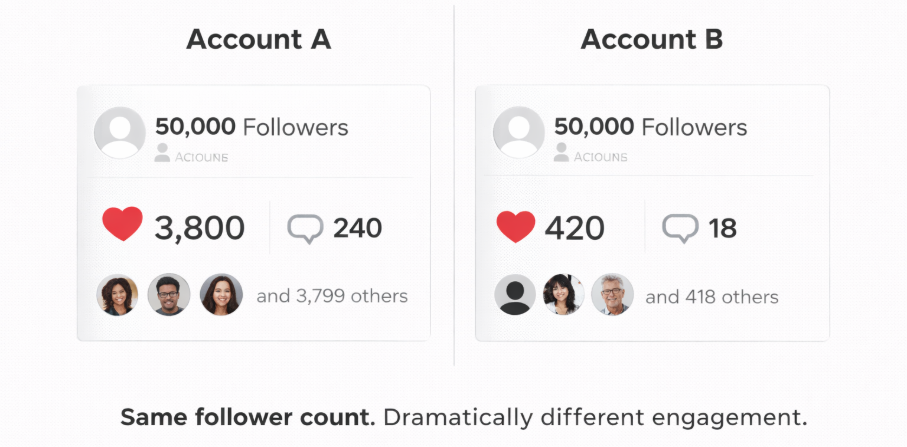
Followers count alone no longer define performance on social platforms. Two accounts with the same number of followers can experience very different reach, visibility, and growth outcomes.The difference often comes down to one factor: engagement relative to follower size.
That is why the followers to engagement ratio has become one of the most reliable indicators of account health in 2026.
What Is the Followers to Engagement Ratio
The followers to engagement ratio compares how many interactions a piece of content receives relative to the total number of followers an account has. Engagement typically includes likes, comments, shares, saves, and in some cases meaningful replies or direct interactions. This ratio answers a critical question. Are followers actively responding to content, or are they mostly inactive observers? It shifts focus from audience size to audience activity.
Why Engagement Ratio Matters More Than Followers
Modern social algorithms prioritize signals that indicate user satisfaction. Engagement is one of the strongest indicators of content relevance.
When engagement is high relative to follower count, it suggests:
- Strong content relevance
- Clear audience alignment
- Healthy interaction patterns
When engagement is low relative to follower count, it often signals:
- Inactive or disengaged followers
- Mismatch between content and audience
- Weak early performance signals
This explains why smaller accounts sometimes outperform much larger ones. A compact but active audience can generate stronger distribution signals than a large passive following.
How Algorithms Interpret Engagement Signals
Most social platforms distribute content in phases.
1. Initial exposure is given to a portion of followers or a test audience.
2. Performance is evaluated based on engagement signals.
3. Distribution expands or is suppressed depending on results.
Engagement ratio plays a critical role during the evaluation phase. If a meaningful percentage of followers interact quickly, the platform interprets the content as relevant. If interaction is weak, expansion slows. Followers create potential reach. Engagement determines whether that reach continues.
What Is a Healthy Engagement Ratio
There is no universal percentage that defines a healthy ratio across every platform and content format. However, performance patterns offer useful guidance.
At a general level:
- High engagement means content consistently receives visible interaction from a meaningful portion of followers.
- Moderate engagement means interaction exists but fluctuates noticeably between posts.
- Low engagement means posts receive minimal interaction relative to total followers.
Consistency is more important than occasional spikes. A stable engagement ratio over time reflects sustainable audience interest.
Platform Differences in Engagement Expectations
Engagement ratios must always be evaluated within platform context.
Instagram still uses follower relationships in early distribution. Engagement ratios strongly reflect audience alignment and content resonance.
TikTok
TikTok operates on a discovery-first model. Engagement can fluctuate widely because distribution depends heavily on performance testing rather than follower exposure.
YouTube
YouTube places heavier emphasis on watch time and retention rather than visible interactions. Comment and like ratios matter, but audience retention often carries more weight.
A healthy ratio on one platform may not look identical on another. Context determines interpretation.
Engagement Ratio vs Reach
Engagement and reach are connected but not identical metrics.
- High engagement often supports wider reach because it signals relevance.
- High reach does not automatically produce strong engagement ratios.
A piece of content may reach a large discovery audience but generate limited interaction if viewers do not connect deeply with it. This is why some viral posts fail to convert into long-term audience growth.
When a Low Ratio Becomes Concerning
A low engagement ratio becomes problematic when it persists over time.
Common causes include:
- Audience growth without clear targeting
- Inactive followers accumulated over time
- Content shifts that alienate the original audience
- Overly broad content that weakens identity
If low engagement continues across multiple posts, early distribution signals weaken and performance volatility increases.
Inactive Followers and Ratio Distortion
Inactive followers distort engagement ratios by increasing total follower count without contributing interaction. As the denominator grows while engagement remains flat, ratios decline. Platforms interpret this as reduced content relevance. Over time, distribution may become more cautious, limiting reach even further. This is why follower quality matters more than follower volume. A smaller active audience often produces stronger performance stability than a large inactive one.
Improving Engagement Without Chasing Vanity Metrics
Healthy ratios improve when content and audience alignment strengthen.
Effective approaches include:
- Maintaining a clear content focus
- Delivering consistent thematic value
- Understanding audience expectations
- Encouraging meaningful interaction rather than passive reactions
Engagement built on relevance tends to stabilize over time. Engagement driven by short-term tactics often produces volatility.
Why Trends Matter More Than Single Posts
Individual posts can perform unusually well or poorly. Algorithm shifts, timing, or external factors can distort isolated data points.
What matters more is trend consistency.
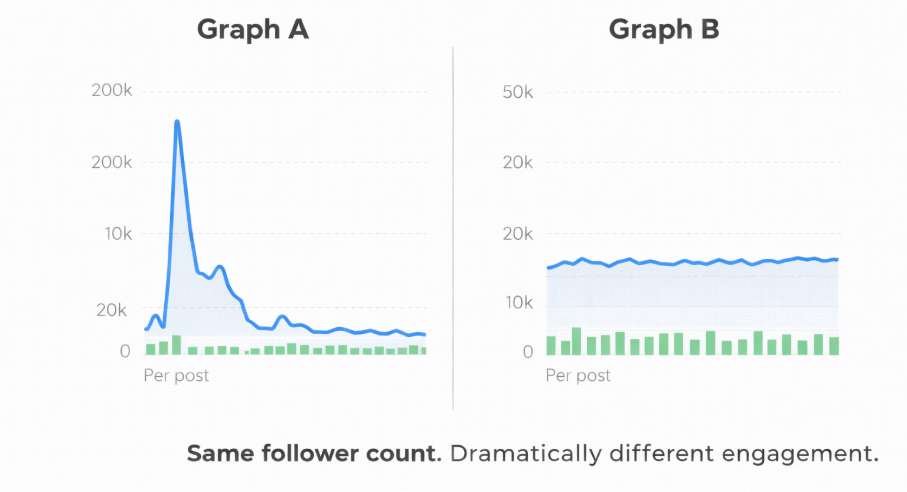
- Is engagement stable across weeks and months
- Does interaction scale proportionally with follower growth
- Does performance recover after temporary drops
Tracking engagement trends provides a clearer diagnostic view of account health than evaluating single post spikes.
Using Engagement Ratio as a Strategic Tool
The followers to engagement ratio should not be treated as a vanity benchmark. It is a diagnostic tool.
It helps answer practical questions:
- Is my audience still aligned with my content
- Did recent growth improve or weaken overall performance
- Are algorithm changes affecting distribution patterns
- Is my community active or passive
When used strategically, the ratio supports informed adjustments rather than reactive content decisions.
A Balanced Perspective on Account Health
A healthy followers to engagement ratio reflects balance.
- Followers represent potential reach.
- Engagement represents realized value.
When both grow together, performance becomes more resilient. When follower growth significantly outpaces engagement, instability increases. In 2026, sustainable growth is not defined by scale alone. It is defined by alignment between audience size and audience activity.
FAQs
What is a good engagement rate for social media in 2026?
There is no universal number, but stable and consistent interaction from a meaningful portion of followers generally indicates healthy performance. Platform context always matters.
Does a high follower count guarantee strong engagement?
No. Large follower numbers do not automatically produce high engagement. Audience alignment and content relevance are more important.
How often should I monitor my engagement ratio?
Reviewing engagement trends weekly or monthly provides useful insight. Daily fluctuations are normal and should not drive major strategy changes.
Can removing inactive followers improve engagement ratio?
Removing inactive followers may improve visible ratios, but long term performance depends more on producing relevant content than on adjusting follower counts artificially.